After 26 hours of trains, airplanes and tuk tuks we arrived in Galle, Sri Lanka. Coming from snowy Moscow the change in temperature and humidity was quite noticeable. We enjoyed the Dutch colonial town of Galle and rented a scooter (1000 rupees, $7) for a side trip to have a cocktail on Unawatuna Beach, visit a Peace Stupa and take a small hike down to Jungle Beach.
Jungle Beach
We hopped on a bus and headed to the long stretch of beach with loads of guesthouses, restaurants and bars right in the sand called Mirissa. One end is party central with spotlights, fireworks and pumping music all night but you can find quiet and solitude on the East end.
East end of Mirissa BeaChPassion fruit mojito, Mirissa Beach
We rented a scooter again (locals call them scooties, very cute) and visited a temple with a giant Buddha statue along with another reclining Buddha in the town of Matara.
After three nights in Mirissa (and seeing several other beaches in the area, some great for learning to surf, others for solitude) we took a bus to Tangalle, then a tuk tuk to our remote guesthouse in Marakolliya Beach.
A great example of the colourful Sri Lankan busIan enjoying the hammock, Marakolliya Beach
Our place was situated on a lagoon that flowed into the ocean just steps away. We could watch the fish, snakes and kingfishers in the lagoon while having lunch, then stroll down the long, almost empty beach. It was serene!
The name of our tour was ‘Arctic Explorer: Northern Lights, Northern Culture’. It was on our third night of searching for the lights that we saw them near the town of Murmansk. My brother Rob was able to capture this mystical sight with his professional camera. You can see his photos at http://apolymath.com/northern-lights/
Murmansk also included a visit to the decommissioned nuclear powered icebreaker Lenin.
Lenin, the world’s first nuclear-powered icebreaker
On our way south towards Moscow we were treated to a traditional Russian Christmas show in the town of Petrozavodsk.
Russian Christmas show
We also visited the small town of Suzdal which has several UNESCO World Heritage sites. It was one of the original Golden Ring towns and dates back to 1024.
Holy Transfiguration Church In the Museum of wooden architecture and peasant life, Suzdal
We finally made it to Moscow and had the great tour of The Armory, Kremlin and Red Square. The Armory is full of royal treasures such as faberge eggs, crowns, thrones, coronation gowns and even carriages. Too bad there are no photos allowed!
The KremlinRed Square, Moscow
Ian and I ended our Russian trip with a visit to the famous Moscow metro, otherwise known as ‘Palaces for the People’. Next up: Sri Lanka!
Happy New Year! We began 2018 in Russia on The Golden Eagle Trans-Siberian Express Train on the way to Norway. Dinner was served on the train with an abundance of vodka that consequently sent me to my cabin for the night while everyone else disembarked for a fireworks and fire dancing show to ring in the new year. On New Years day we crossed the Arctic Circle!
Kirkenes, Norway. Locals claim tHis church is haunted and hence the clocks never match.
We passed through the Russian/Norwegian border quite smoothly and took a bus to the town of Kirkenes, famous for the part it played in WWII. We visited the Andersgrotta bomb shelter built to hold 2,500 people and protected them for a total of 328 air raids. There was no heat, light, or bathrooms in the rambling tunnels as the town was bombed and burned down above.
Andersgrotta bomb shelter, Kirkenes
Then it was time for a snowmobile sled ride to the frozen fjord to catch our lunch of delicious king crab. Turned out the crab was caught the night before so we witnessed the traps being hauled out of a hole in the ice and the crabs being quickly dispatched by a knife. They are called ‘King’ crabs because of their blue blood.
King crab FISHING
The sun never rose while we were in Polar Night in Norway, so most of my pictures are a bit dark or blurry. Take for example this one of the dog sled adventure we had in late afternoon!
Soma and Dad ready for the dog sled adventure
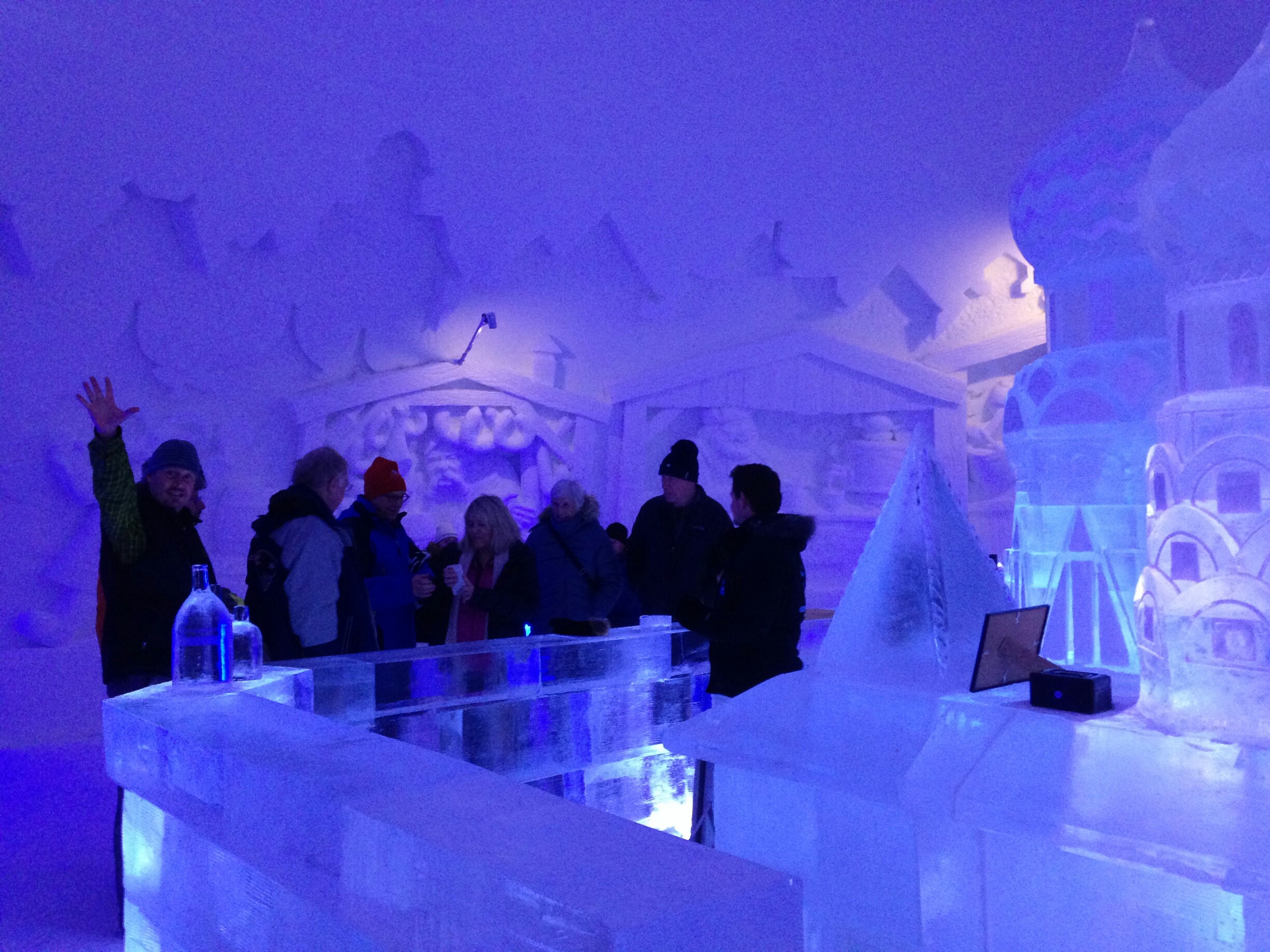
There’s nothing like a vodka shot served from a glass made of ice at the Kirkenes Snow Hotel at the end of a dog sled ride.
Ice Bar at The Snow hotel
Each room in the snow hotel has its own beautifully carved theme. If you are brave enough to stay overnight (unfortunately we didn’t get to) you are given a thick sleeping bag and a balaclava to spend the night in your personal igloo art piece. I heard that it’s cozy indeed and super quiet. Only problem is putting on your boots and clothes to run down the snow corridor to use the WC in the night!
One of the beautifully carved rooms in the snow hotel. Note the ice headboard!
There was plenty of activity at The Snow Hotel including a reindeer farm, snow shoeing and visiting the husky farm full of excited, vocal sled dogs. They provided us with snow suits, mittens, boots, socks, and balaclavas when needed.
Entrance to the Ice Bar at The Snow Hotel
Although Kirkenes was bathed in darkness for most of the day and the sun never rose in the polar night we discovered the warmth in the hearts of her people. And the laughter we shared was more than enough to brighten our days!
Russia! Did I ever imagine going there? Honestly No. Given the current political climate and growing up in the Cold War plus Russia is COLD in the winter, it’s kind of a miracle that I ended up there. My parents generously gave Ian and I (plus our son, Soma and brother Rob) tickets to join them on The Golden Eagle Trans-Siberian Express train from Saint Petersburg up to Norway and ending back in Moscow.
Kazan CathedralCatherine Palace, 15 miles from St. PETERSBURG
The elaborate and somewhat somber history of Russia is best left to the people who inhabit it’s vast lands, and the history experts. I only wish to share some of the incredible beauty that was my pleasure to witness.
Catherine Palace
Saint Petersburg is known for it’s canals, museums and beautiful architecture. We had the incredible opportunity to have first access to see The Hermitage Museum before the crowds arrived! Truly amazing and rare experience, we even saw the famous Peacock Clock go through its paces (only kings, presidents and the fortunate few have witnessed this amazing feat in person).
The Hermitage MuseumInside The Hermitage
The Church of the Savior on Spilled Blood was built on the exact place that Alexander II was assassinated in 1881. Remembered as one of Russia’s greatest tsars, he emancipated the peasant serfs in 1861.
Church of the Savior on Spilled BloodInterior of Church of the Savior on Spilled Blood
Another beautiful church we visited was Saint Isaac’s Cathedral.
Interior of Saint Isaac’s Cathedral
The borscht was delicious, the temperature frigid, the Russian dolls gorgeous in shop windows as snowflakes fell. The sky was dark except for a couple hours each day. We boarded the train and headed north to Norway!
Back to Spain we flew! Barcelona was gorgeously unreal, creatively genius, inspirational.
The renowned Casa Batllo by Antoni GaudiCasa Mila, designed by Antoni Gaudi
We loved seeing Antoni Gaudi’s many works of art and architecture throughout the city, with the icing on the cake being the Sagrada Familia, which is still under construction with the end date forecasted for 2026 (one hundred years after his death).
Ceiling and post details, Sagrada Familialight from stained glass windows in the Sagrada Familia
And of course the delicious tapas!!!
Tapas in Barcelona
We spent 4 hours on 2 trains to get from Barcelona to Cuenca. This town is famous for its ‘hanging houses’. It reminded me of Ronda, Spain.
The famous ‘hanging houses’ of CuencaBalancing act in CuencaCuenca, UnescO WORLD HERITAGE SITE
With it’s steep cobblestone streets, hanging houses, beautiful views of limestone cliffs and the town’s unique home made liquor, this is a perfect place to relax just an hour from Madrid. Salud!
Portugal charmed us with it’s medieval castles, brightly painted towns, delicious wine and port, morello cherry liquor (ginjinha) served in edible chocolate cups and fresh seafood.
TORRE DE BELEM, UNESCO WORLD HERITAGE SITE IN LISBONVinho Verde and Portuguese style sea bass
This palace in Sintra looks like a fairytale but it’s construction actually began in the Middle Ages as a monastery. It’s current appearance is due to the work commissioned by King Ferdinand II. The inside rooms have been restored to how they were in 1910 when Queen Amelia stayed there before fleeing to Brazil.
Palacio da Pena, Sintra. UNESCO World Heritage site
The coastal town of Nazare hosts the Big Wave Surf Competition every winter between October and February. Some of the world’s largest waves have been surfed here, including Garrett McNamara’s of 78 feet! We saw it on a mellower day :).
Jet ski and surfErs, NAZARE
We rented a car to have the freedom to visit some northern towns and cities. We ended our tour in beautiful Porto, where the Douro River flows into the sea and you can taste the best port in the world!
Enjoying the view from the castle walls in ObidosAveiro, the Venice of PortugalRabelo boats, used to transport port wine along the Douro River. Porto, Portugal
Travel Tip – the road map for Portugal can sometimes look like spaghetti and time can warp when the mists reveal castle turrets in the woods. We followed the advice given in Yann Martel’s novel The High Mountains of Portugal and when the road got to us, we drank wine!
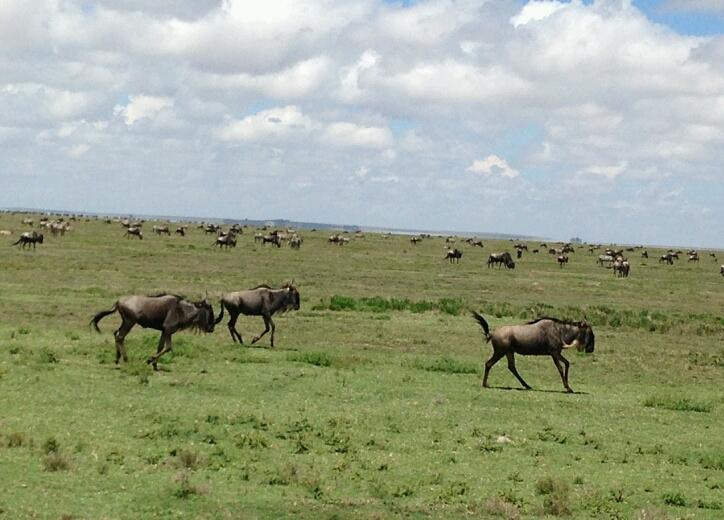
Wildebeest, The Great Migration, Serengeti National Park
Our four day and three night Tanzanian Safari was amazing beyond my highest expectations. We witnessed The Great Migration, saw a Black Rhino (on the brink of extinction, only 20 left in Ngorongoro Crater), survived meeting a Black Mamba (second largest venomous snake in the world), and were 10 feet away from several lions at different encounters.
Giraffes in Ngorongoro Crater
These photos were all taken on my iPhone so you can just imagine what beautiful pictures Ian was able to take with his good camera and zoom lens. Due to resizing issues alll photos on this blog have been from my iPhone.
Giraffe in Lake Manyara National ParkZebras in Serengeti National ParkZebras in Lake Manyara National ParkZebras in Serengeti National ParkBaboons in Ngorongoro CraterElephant in Tarangire national park
And our favorites, the lions!
Lion cub in Serengeti National ParkLions in Serengeti National ParkFemale lions in Serengeti National ParkLion on the crater rim, Ngorongoro Crater Conservation Area
Zanzibar, an island rich in history for the old slave market and world renown spices. Now you can watch the locals gathering seaweed during low tide which they sell for cosmetic use.
Maasai maN and seaweeD harvesters at low tide
We knew that the the tide goes so far out in Jambiani that you can only swim during parts of the day. Instead of a hindrance this became one of the highlights of our trip. Not only for the fun of walking out and seeing baby eels, reef fish and sea stars but for the amazing culture of this area as women and men harvested the seaweed and carried it in huge bags on their heads.
View of outrigger fishing boats in the tepid Indian Ocean
There is a lot more to Zanzibar island than it’s warm turquoise water and powder sugar sand. You can experience spice farms, witch doctors, a huge seafood BBQ market in Stone Town, crazy full moon parties in Paje, mangroves and an endangered species. Introducing the Zanzibar Red Colobus monkey, who can only live in Zanzibar where it can find the 60+ different plant species it needs to survive.
Zanzibar red Colobus monkey, endangered speciesZanzibar Red Colobus
You can see these adorable primates (who only have 4 fingers and no thumb) in Jozani Chwaka Bay National Park. There are also Sykes monkeys living in harmony with the Red Colobus.
Sykes monkey
Travel Tip- you’ll be approached by many different people selling tours. We rented a kayak with snorkel gear for $10 an hour (total for two) and did our own ‘snorkel tour’. Another day we rented a scooter for $25 and drove all around including Jozani Park ($10 each entrance fee) and the Butterfly Center ($5 each). Another important Travel Tip- there are NO ATM machines on the East side of the island, so get your shillings in Stone Town before your taxi ride across. Yes, it’s shillings, and it takes 2,000 to equal one US dollar (as of this writing) so be prepared for a little heart attack when you get your first bill (we had a fancy lunch that cost 89,000).
The beach in Stone Town
You will probably learn some Swahili phrases from the exuberant locals, and if nothing else sticks you will still walk away with ‘Jambo!’ (Hello). This is shouted by smiling children on the beach, shop keepers sitting in the shade, and every person you pass on the street or strolling down the white sands.
We cleverly planned a 15 hour layover in Istanbul on our way to Tanzania. Breakfast, Blue Mosque, lunch, old town, dinner. Travel Tip – as of October 2017 if you are a United States passport holder you are not allowed into the country of Turkey. We tried looking cute, we tried despondent, we talked to three different people but ultimately spent 15 hours in the airport. They gave us two food vouchers, one for breakfast and one for dinner and you can still drink Turkish coffee, but…..15 hours is a long time in an airport.
Our last stop in Morocco was the clamorous and gaudy medina of Marrakech. Getting lost while trying to find our Hamam made it all the more worthwhile to have buckets of hot and cold water dumped on our heads. Our skin was baby-butt smooth after a young lady scrubbed off half an inch of skin with a scratchy black salt glove.
The Medina quarter (old city)
The touts were intense, the food deliciously flavored with spice and the show unending in the famous square of Jemaa el-Fnaa. Snake charmers, story tellers, musicians, and artisans are found here everyday, all day. You can peruse the food stalls proudly displaying their severed goat heads to tempt your palate.
Jemaa el-Fnaa, the never ending spectacle in the medina quarter
Travel tip- if a lady grabs your arm and starts writing with a henna pen and tells you a ‘free gift’, just run. Unless you want to pay for henna, of course. I call this mark ‘The Tourist Stamp’.
Tourist stamp and white wine
Morocco’s first language is Arabic, the second is French. Cheers to a great adventure, a wonderful country full of curious and friendly people and delicious delectables. Shukraan and au revoir Morocco!